


Synonyms
Brumus maculatus Pope, 1954: 127.
Brumoides maculatus: Slipinski and Giorgi 2006: 268.
Diagnosis
This species is easily distinguished from B. piae by its larger size, appendiculate tarsal claws and separate lateral maculae on the elytra.
Description
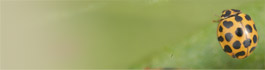
Length 3.3-3.5 mm. Surface predominantly yellowish; each elytron with 3 brownish maculae; a slightly transverse basal lateral one, a post-median transverse one, constricted medially or completely divided in some specimens, and a small rounded one at apical fifth of elytra. Body slightly elongate and flattened. Head flat between eyes; micro reticulate between punctures; punctation smaller than eye facets, nearly 2.5 diameters apart. Eyes dorsally separated by about 3 times the width of an eye; inner ocular margin conspicuously diverging apically. Antenna with scape symmetrical, slightly larger at apex; pedicel barrel-shaped, about as long as scape; antennomeres 3 and 4 very similar in size and shape, somewhat trapezoidal; 5th 1.5 times as long as 4; 6th 1.5 times as long as 5th; 7th somewhat conical in lateral view, slightly shorter than 6th; 8th partially embedded in the 7th. Terminal maxillary palpomere weakly securiform. Terminal labial palpomere robust, about 2 times as long as basal width; slightly shorter than preceding segment. Pronotal surface sculptured as on head; punctation almost obsolete, very shallow; prosternum relatively long in front of coxae, slightly more than 2 times longer than prosternal process widest width; tarsal claws distinctly appendiculate. Elytral punctation stronger than on pronotum; epipleura narrowing abruptly medially. Abdomen with ventrite 6 slightly emarginate at apex; 5th wider than 4th; surface of ventrite 1 micro sculptured between postcoxal lines; postcoxal line almost reaching midpoint of lateral line. T
Male
Tegmen relatively short about 1/2 the abdomen length; penis guide distinctly shorter than parameres; parameres densely setose at apex, the setae long; strut long, about 1.5 longer than tegmen; penis as figured.
Female
Externally identical to male.
Variation
Not observed.
 Distribution and Biology
Widely distributed along the coast of Western Australia, Northern Territory and Queensland, west to Cape York.
Species References
Pope, R. D. 1954. Coleoptera: Coccinellidae from the Monte Bello Islands, 1952. Proceedings of the Linnaean Society of London, 165, (1): 127.
Slipinski, S.A. 2007. Australian Ladybird Beetles (Coleoptera: Coccinellidae) their biology and classification. ABRS, Canberra. 286 pp.
Slipinski, A. and Giorgi, J.A. 2006. Revision of the Australian Coccinellidae (Coccinellidae). Part 6. Tribe Chilocorini. Annales Zoologici (Warszawa), 56(2): 265-304.
[ Top ]